Turkeys Are Friends, Not Food
Photos and Text by Beth Lily Redwood
Someone, Not Something
Time after time, the turkeys one meets at farm animal sanctuaries are there because the person who originally bought the turkey, intending to raise them to kill and eat, had a profound change of heart and wanted to find a home where their turkey friend would have a long, healthy, happy life. As they came to know and cherish their turkey, the person realized that their friend was an individual and every bit as full of personality, feelings, thoughts, affection and lovable qualities as their dogs and cats who were treated as family members.
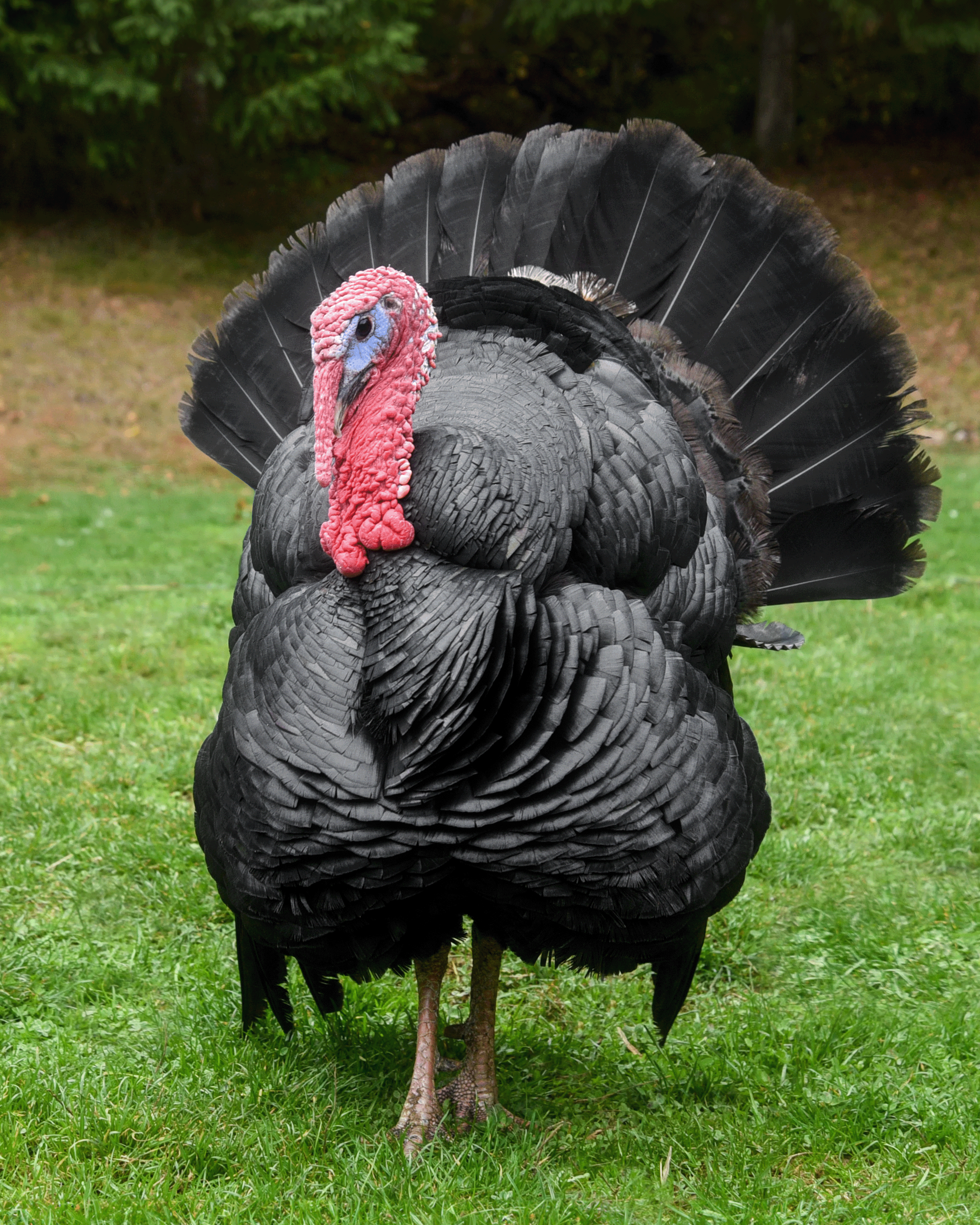
Charles was a “people turkey” who enjoyed welcoming visitors and displaying his beautiful feathers for admiring friends at Wildwood Farm Sanctuary & Preserve.
Charles, “the Lionhearted,” was purchased by a family as a baby poult to be raised by their son for a Future Farmers of America (FFA) program. The son raised Charles for Thanksgiving dinner but then realized that Charles was his friend—a caring, fun, interesting, soulful companion—and killing or eating Charles became a repulsive idea. Instead, the family brought Charles to a sanctuary to live his best life.
“Charles had a huge personality. He absolutely loved being around people and was the first to greet folks when they arrived at our sanctuary. … When Charles became elderly and needed more specialized care, he was moved up to the main house area but still managed to make the trek down our long driveway to the main barn to greet visitors. He definitely knew what a camera was as he loved posing for photos, fanning his gorgeous tail at any opportunity to be admired. Charles was the sweetest turkey I've ever known.” –Shauna Sherick, Wildwood Farm Sanctuary & Preserve
Sanctuaries are places of safety and respect that offer rescued turkeys their best and longest life. Turkeys you meet at sanctuaries have names, stories, unique personalities, and are individuals in their own right. Some of the most memorable ones I’ve met are Jude, “the Stowaway,” a shy boy at Animal Place who hid when thousands of his kin were taken to the slaughterhouse but who learned to trust people and became an affectionate cuddler; Mr. T, “the Guardian,” a friendly and talkative fellow at Out to Pasture Sanctuary who loves treats, likes to stroll along with visitors and watches over the ducks; Clover, “the Heartthrob,” a sweet boy who loves to be the center of attention at Wildwood Farm Sanctuary & Preserve, but who also has an independent side and goes on walks by himself exploring the sanctuary; and Annabelle and Coquette, “the Beauties,” at Veganville Animal Sanctuary who are best friends and enjoy being caressed under their wings.
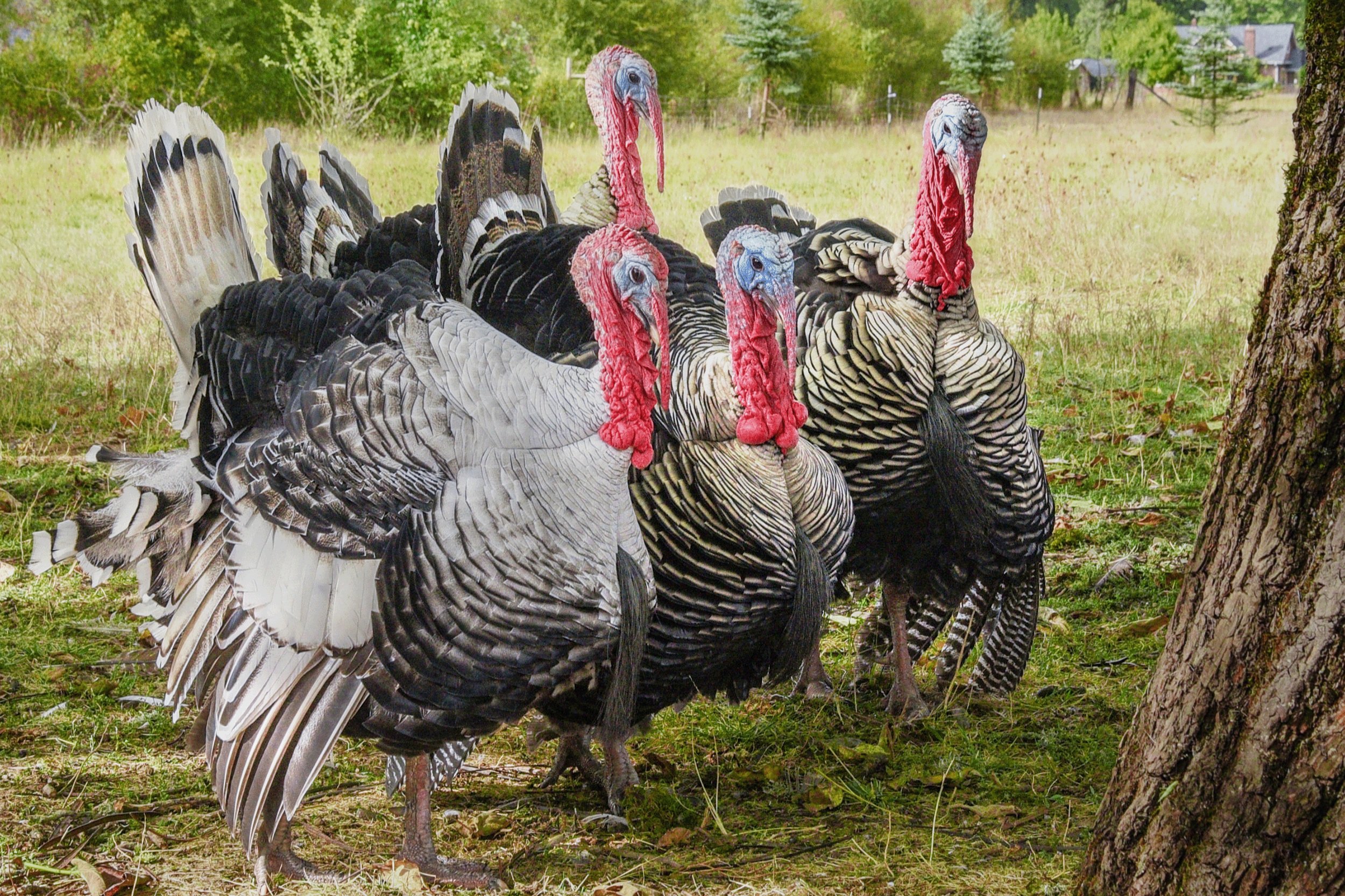
Rufus (front row, second from left) hanging out with his posse of best friends at Lighthouse Farm Sanctuary.
“Rufus was ‘the King Turkey,’ a super friendly sanctuary greeter, the leader of the flock. He was gregarious, outgoing, and let people see his personality. He loved to do his turkey dance for people whenever anyone was paying attention because he just loved to dance. He was open to getting to know humans, open to having friendships, and excited to see the people he loved. He had a posse of three guys he hung around with, but he was really sweet with the ladies too. He was a gentleman, very sweet, a very gentle spirit.” –Gwen Jakubisin, Lighthouse Farm Sanctuary
Reasons to Be Kind to Turkeys
“Turkeys must be among the most charming and gentle beings on the planet. They want nothing more in life but their basic needs, peace, company, and hugs. Most of the animals living at our sanctuary are very affectionate but the turkeys surprise people the most. They are every bit as loving as cats and dogs, if not more so. … When we see them with their wings spread out, purring and begging for our love and attention, we stop to hug them and treasure them. … If you met one of them, it would be very difficult for you to kill someone who wanted nothing from you but respect and a hug.” –Sandra Higgins, Eden Farmed Animal Sanctuary
Turkeys are highly social animals who form long-lasting, close friendships with each other and with human companions.
Turkeys are affectionate and often appreciate being petted, stroked and cuddled by humans just like the companion animals we know and love.
Turkeys are intelligent, curious, natural detectives who enjoy roaming, foraging, and exploring the sights, sounds, and geography in their territories.
Turkeys communicate with a rich vocabulary of over 20 distinct sounds and tones, including purrs similar to cats, and they can recognize each other by their voices.
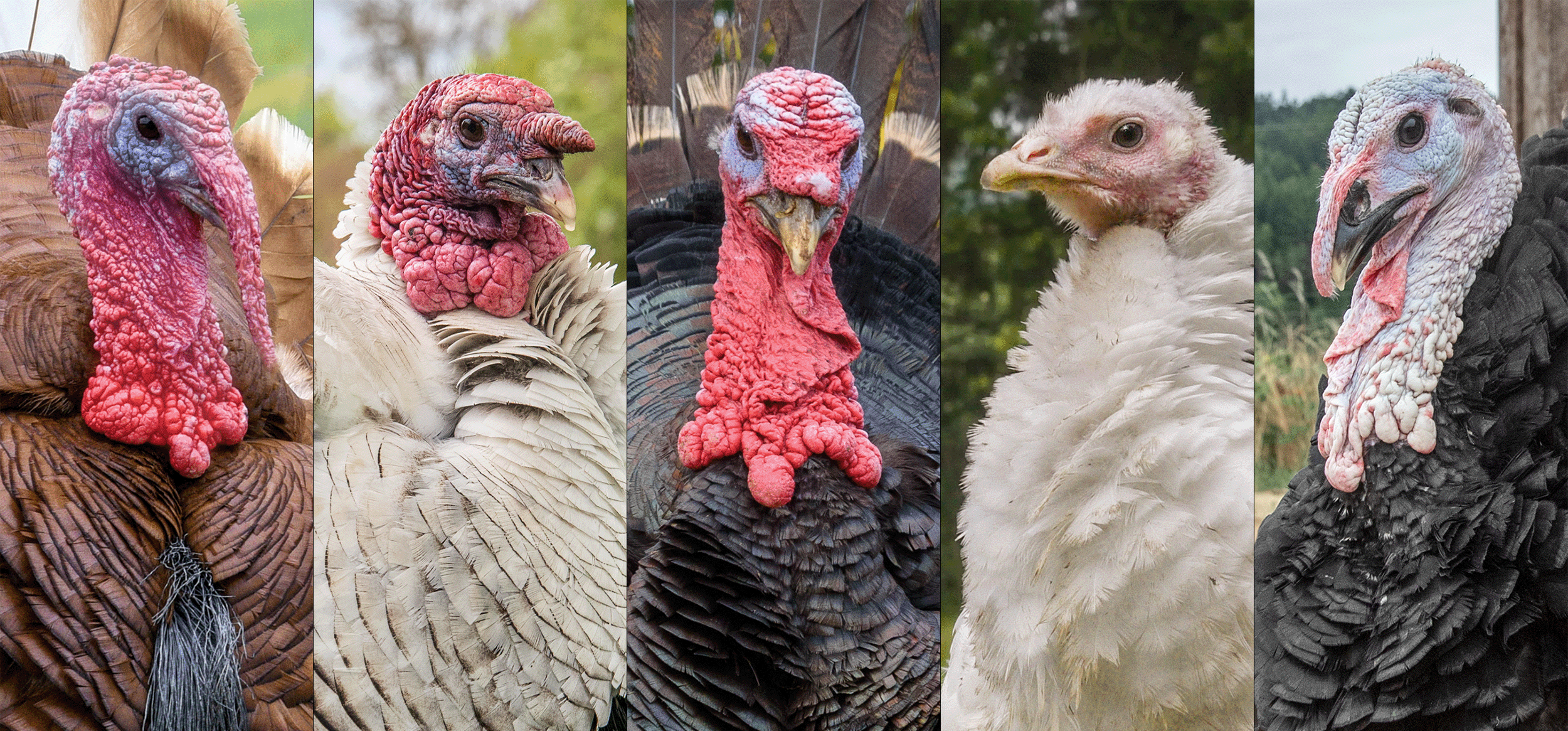
Turkeys are known as “nature’s mood rings” because the color of their head and throat changes colors depending on how they are feeling.
Turkeys have exceptional eyesight that is three times clearer than humans. They possess a wide, 270-degree field of full-color, periscopic vision and can even see ultraviolet light.
Turkeys naturally want to move their bodies, to walk, run, strut, perch, roost, spread their wings, fan their feathers, swim, fly, and mate. Wild turkeys can fly up to 55 mph.
Turkeys naturally choose to be clean and comfortable, so they preen their feathers and dust bathe to maintain good plumage and remove insects.
Turkeys have a zest for life and like to have fun. They have been known to play with round objects, to frolic, dance, and vocalize along with music.
Turkeys living today evolved from their ancestors who lived about 100 million years ago and includes tyrannosaurus rex and velociraptors.

With their mutual curiosity, friendliness and sense of adventure, good buddies Mr. T and Pepper check out the comings and goings at Out to Pasture Sanctuary. How could it be right that we call one of them “friend” and the other “food”?
The Grim Reality
If you had the heart-opening experience of meeting Charles, Rufus or any other rescued turkey who had shown you their truest self—how sweet, gentle, friendly, smart, and personable they are—you would understand that the suffering and death endured by 46 million turkeys who are killed for Thanksgiving each year in the United States is unconscionable.
Every aspect of a commercially raised turkey’s life is engineered to maximize their final weight for profit. Soon after hatching in an incubator without their mother’s presence, young turkeys have their beaks, toes and snoods (the fleshy part of their face that lies over their beak) painfully mutilated without anesthesia. They are bred to grow so abnormally fast that “if a seven-pound human baby grew as fast as baby turkeys are forced to grow, the human baby would weigh 1500 pounds at 18 weeks old,” according to United Poultry Concerns. These turkeys are also genetically manipulated to grow huge breasts so disproportionate with the rest of their bodies that they have trouble standing, walking, and mating—in fact, they must be artificially inseminated to reproduce. Tightly confined wing-to-wing with thousands of birds, turkeys spend their lives standing and sitting in their excrement on filthy, litter-strewn floors, breathing ammonia-laced, polluted air in pathogen-infested sheds. Although turkeys can live 10 years, farmed turkeys are killed at five months of age on average—four percent of their natural lifespan.
“The legacy of this great desire for their flesh sees the turkey of today with breasts so large and growth so quick, that flight has been reduced to an impossible dream along with the ability to mate naturally. … This human-directed evolution, devoid of kindness but keen on profits, has meant these intelligent, curious and friendly birds reach their target slaughter weight in the shortest period of time in history—around five months. And so often in a state of both chronic and acute pain. Many walking on bowed legs, suffering painful hock burns, and enduring respiratory and cardiovascular conditions. They are raised in sheds filled with excrement, fear and despair where the very air sears their delicate nostrils, eyes, lungs, and sadly so often their will to live. And so too it would our hearts, if only we had the courage to witness this human inflicted suffering. But we do not.” –Pam Ahern, Edgar’s Mission
Turkeys are at home in nature where they breathe fresh air, feel sunlight, move freely, and connect with the earth. They innately know how they are meant to live. The extreme confinement and deprivation of everything that is natural to them, that is alien to any environment where they could thrive, causes immense suffering to their body, mind, soul and spirit.
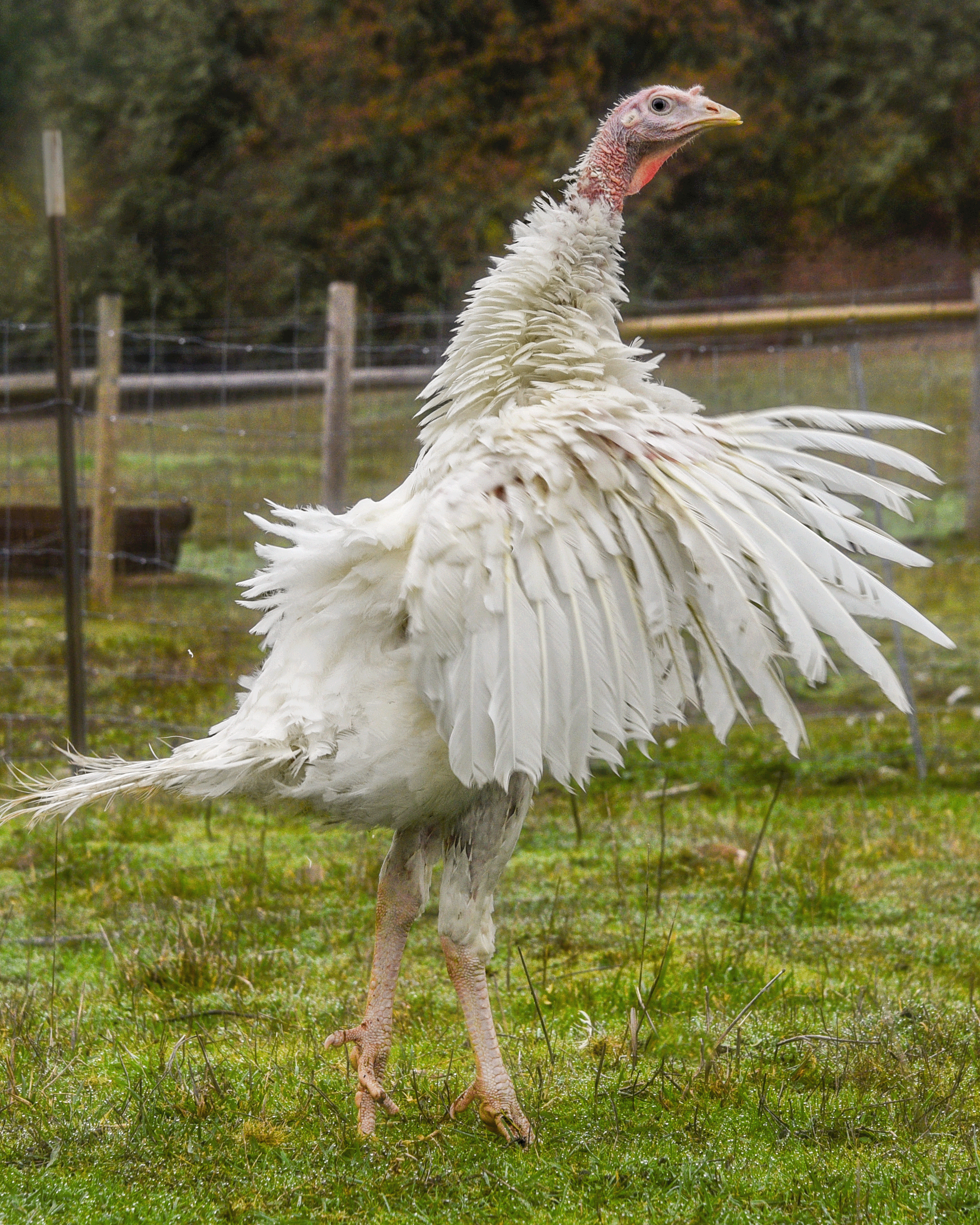
(Pictured) Although her toes and beak were mutilated, Mercy, “the Ballerina,” gracefully stretched her limbs at Wildwood Farm Sanctuary soon after she was rescued from a turkey farm and saved from slaughter.
Inhumane Slaughter Methods
Sadly, turkeys and chickens are excluded under the federal Humane Slaughter Act which requires “humane” handling of animals before and after slaughter. The law requires that livestock animals be completely sedated and insensible to pain before being shackled, hoisted, thrown, cast, or cut. Despite birds comprising 98 percent of the animals slaughtered for food in the United States, there are no legal protections to render them unconscious or unable to feel pain when killed.
“At the slaughterhouse, turkeys are torn from the crates and hung by their feet upside down on a movable belt—torture for a heavy bird especially. They may or may not be ‘stunned’—paralyzed while fully conscious—by a handheld electrical stunner, or by having their faces dragged through an electrified water bath. The purpose of electrical ‘stunning’ is to paralyze the muscles of the feather follicles ‘allowing the feathers to come out easily’ and has nothing to do with humane slaughter. The electricity shoots through the birds’ eyes, eardrums, and hearts causing ‘intolerable pain’ according to researchers. Nor does throat-cutting, with or without prior electric ‘stunning,’ produce a humane death.” –Karen Davis, United Poultry Concerns
Why Do People Eat Turkeys?
For decades, eating turkeys has been associated with Thanksgiving, and most people do not question their participation, despite identifying as “animal lovers” who would never want to cause animals to suffer. Tradition, habit, convenience, social pressure, and taste are often cited as reasons. Are any of these reasons more important than taking the life of someone who didn’t want to suffer and die? Earthling Ed put it succinctly, “Are my taste buds more important than the life of an animal?”
Many people are also unaware of how deeply carnism—the dominant, violent, invisible belief system that conditions us to eat certain animals—has caused us to engage in behavior which requires us to “distort our thoughts, numb our feelings, act against our core values … and shut down our awareness so that corpses are perceived as cuisine,” according to Melanie Joy, PhD, founder, Beyond Carnism.
In addition, most people are unaware of how horrifically turkeys suffer in the ways they are traditionally raised and killed since turkey farms and slaughterhouses are not accessible by the public, and ag-gag laws criminalize whistleblowers, undercover investigators, and journalists who try to inform the public about animal cruelty. Law professor Justin Marceau explains: “Industrial agriculture has worked very hard to keep the suffering of animals a secret. From ag-gag laws, to meat-libel provisions, to the targeting of activists, slaughterhouses have ensured that they will not be subjected to the proverbial ‘glass walls.’” As Paul McCartney famously said, “If slaughterhouses had glass walls, everyone would be a vegetarian.”
Have A Compassionate Thanksgiving
This Thanksgiving, think of the turkey and be grateful for the blessings in your life without depriving someone else of theirs. Plant-based holiday roasts with the taste, protein and nutrition but without the cholesterol, saturated fat and animal cruelty of eating a turkey are available at most supermarkets. Popular brands are Tofurky, Field Roast, and Gardein. Traditional Thanksgiving desserts and side dishes can easily be veganized, and there are endless delicious recipes online (see links at the end of this article).
“The Tofurky Roast was first introduced to a skeptical American public in 1995. It was the first nationally marketed alternative to turkey in the country and instantly began a journey where no meat alternative had ever gone before. The Tofurky Company has now sold over seven million Tofurky roasts. It’s been an honor to be invited into so many homes as a compassionate and tasty alternative to eating a sentient being.” –Seth Tibbott, founder, Tofurky
Thanksgiving community gatherings, like Northwest VEG’s Compassionate Thanksgiving potluck on November 19, or dinner with friends, are a wonderful opportunity to celebrate with like-minded people and enjoy a variety of delicious plant-based holiday foods. Several farm animal sanctuaries offer a “ThanksLiving Celebration for the Turkeys,” where turkeys are the guests of honor. A few sanctuaries also encourage supporters to symbolically “Adopt a Turkey” instead of eating one.
“May we create compassionate Thanksgiving rituals that reflect the fact that neither our values nor an animal have to be sacrificed in order to celebrate this holiday.” –Colleen Patrick-Goudreau
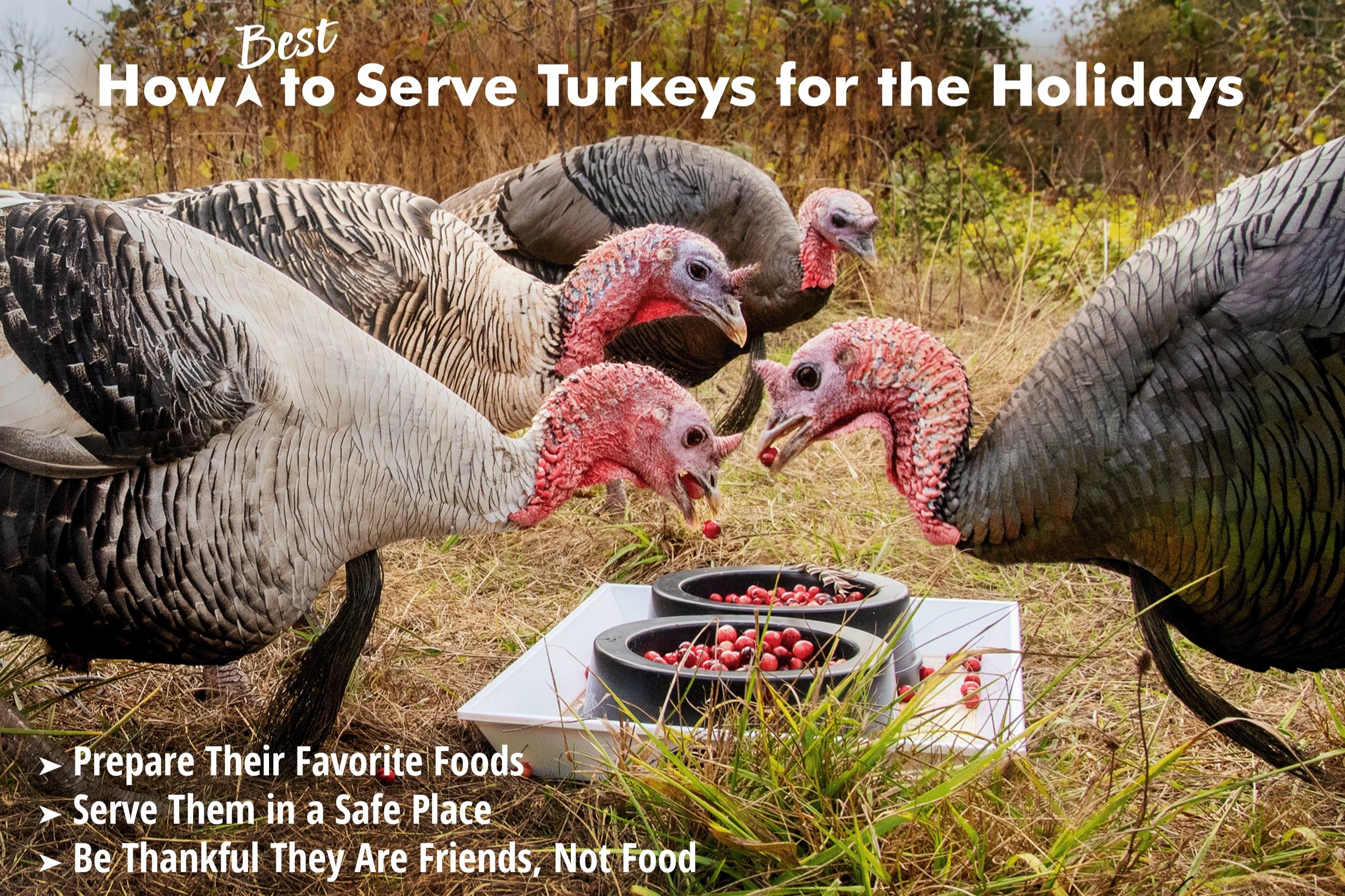
Delicious Vegan Thanksgiving Recipes:
https://www.bonappetit.com/gallery/44-vegan-thanksgiving-recipes-everyone-will-love
https://cooking.nytimes.com/topics/vegan-thanksgiving
https://www.foodandwine.com/special-diets/vegan/vegan-thanksgiving-recipes
https://ilovevegan.com/35-vegan-thanksgiving-recipes/
https://www.marthastewart.com/1125657/vegan-thanksgiving-recipes
https://nutriciously.com/best-vegan-thanksgiving-recipes/
https://sweetsimplevegan.com/50-easy-vegan-thanksgiving-recipes/
https://thegreenloot.com/vegan-thanksgiving-dinner-recipes/
https://vegnews.com/taste-tests/vegan-thanksgiving-sides
Information about turkeys from United Poultry Concerns
Farm Sanctuary’s ThanksLiving Celebration for the Turkeys
Your much-appreciated donations will help support turkeys and other animals living in sanctuaries. Oregon sanctuaries mentioned in this article:
Lighthouse Farm Sanctuary in Scio, OR
Out to Pasture Sanctuary in Estacada, OR
Veganville Animal Sanctuary in Seaside, OR
Wildwood Farm Sanctuary & Preserve in Newberg, OR
Beth Lily Redwood is a photographer, digital artist, graphic designer, writer, and animal rights advocate.